Sparse attention
Name variants 稀疏注意力
Speculative decoding (SD) accelerates large language model inference by reducing the sequential cost of token-by-token generation. Advanced SD methods reduce proposal cost with parallel drafters that predict entire blocks in one forward pass, but overall speedup still depends on acceptance length. On-policy distillation (OPD) can push well-trained drafters b
This explanation quotes or summarizes the cited source record. Saving creates a bookmark on this device, with no automatic account sync.
- First observed in our collection
- Oct 9, 2026, 3:45 PM UTC
- Earliest cited publication
- Aug 26, 2026, 3:03 PM UTC
- Last observed
- Nov 5, 2026, 3:41 PM UTC
Evidence in the last complete seven days
- Source mentions
- 1 Previous seven days 2
- Distinct sources
- 1 Previous 1
- Comparable growth
- Not comparable
- Ranking appearances
- 0
Collection observations and undated records are separate from dated publication counts. Observed in 7d:0 · Undated records:0
Collection coverage · Limited historyCurrent / previous observed days 7 / 3
Counts use complete UTC days. First observed means first seen by this collection, not when a term was coined.
Current window:2026-10-29 → 2026-11-05 (end excluded) · History 11 days
| Source | Current days | Previous days | Last success |
|---|---|---|---|
| arXiv | 6 | 3 | Nov 5, 2026, 10:00 AM UTC |
| arXiv | 7 | 2 | Nov 5, 2026, 10:01 AM UTC |
| Ask HN | 7 | 3 | Nov 5, 2026, 3:00 PM UTC |
| Ask HN | 7 | 3 | Nov 5, 2026, 2:30 PM UTC |
| Ask HN | 7 | 3 | Nov 5, 2026, 3:00 PM UTC |
| Ask HN | 7 | 3 | Nov 5, 2026, 3:00 PM UTC |
| GitHub | 7 | 3 | Nov 5, 2026, 12:15 PM UTC |
| GitHub Issues | 7 | 3 | Nov 5, 2026, 10:01 AM UTC |
| GitHub Releases | 7 | 1 | Nov 5, 2026, 12:00 PM UTC |
| GitHub | 7 | 3 | Nov 5, 2026, 2:30 PM UTC |
| GitHub Issues | 7 | 3 | Nov 5, 2026, 10:01 AM UTC |
| GitHub Releases | 7 | 3 | Nov 5, 2026, 3:14 PM UTC |
| GitHub | 7 | 3 | Nov 5, 2026, 2:30 PM UTC |
| GitHub Issues | 7 | 3 | Nov 5, 2026, 10:01 AM UTC |
| GitHub Releases | 7 | 3 | Nov 5, 2026, 3:14 PM UTC |
| GitHub Discovery | 0 | 0 | Nov 5, 2026, 3:13 PM UTC |
| GitHub Trending | 7 | 3 | Nov 5, 2026, 3:14 PM UTC |
| 7 | 2 | Nov 5, 2026, 10:00 AM UTC | |
| Hugging Face | 7 | 2 | Nov 5, 2026, 8:15 AM UTC |
| Hugging Face Spaces | 0 | 0 | Nov 5, 2026, 3:13 PM UTC |
| Hacker News | 7 | 3 | Nov 5, 2026, 12:45 PM UTC |
| Hacker News | 7 | 3 | Nov 5, 2026, 3:30 PM UTC |
| Hacker News | 7 | 3 | Nov 5, 2026, 3:30 PM UTC |
| Hacker News | 0 | 0 | Nov 5, 2026, 3:13 PM UTC |
| Show HN | 0 | 0 | Nov 5, 2026, 3:13 PM UTC |
| MIT News | 7 | 2 | Nov 5, 2026, 10:01 AM UTC |
| OpenAI | 7 | 3 | Nov 5, 2026, 11:30 AM UTC |
| Product Hunt | 7 | 3 | Nov 5, 2026, 12:45 PM UTC |
| 量子位 | 7 | 3 | Nov 4, 2026, 10:15 AM UTC |
| OpenRouter | 0 | 0 | Nov 5, 2026, 3:41 PM UTC |
| Hugging Face Models | 0 | 0 | Nov 5, 2026, 3:41 PM UTC |
| HF Daily Papers | 0 | 0 | Nov 5, 2026, 3:41 PM UTC |
| OpenRouter | 0 | 0 | Nov 5, 2026, 3:41 PM UTC |
| SEC EDGAR | 7 | 3 | Nov 5, 2026, 10:30 AM UTC |
| Sequoia Capital | 7 | 2 | Nov 5, 2026, 10:00 AM UTC |
| Simon Willison | 0 | 0 | Nov 5, 2026, 3:13 PM UTC |
| TechCrunch | 7 | 3 | Nov 5, 2026, 2:30 PM UTC |
| Contracts Finder | 7 | 3 | Nov 5, 2026, 10:00 AM UTC |
| V2EX | 7 | 3 | Nov 5, 2026, 2:30 PM UTC |
- Counts describe monitored public sources, not the whole web or search demand.
- Both weeks need adequate, comparable collection coverage.
Daily history · up to 90 days
Bars show dated source mentions. The latest UTC day may be incomplete. Zero mentions and missing collection coverage are different conditions.
Dotted markers indicate days with no record. They are not counted as zero mentions.
View accessible daily data
| UTC date | Mentions | Sources | Observations | Ranking appearances |
|---|---|---|---|---|
| 2026-08-26 | 1 | 1 | 0 | 0 |
| 2026-08-27 · No record | — | — | — | — |
| 2026-08-28 · No record | — | — | — | — |
| 2026-08-29 · No record | — | — | — | — |
| 2026-08-30 · No record | — | — | — | — |
| 2026-08-31 · No record | — | — | — | — |
| 2026-09-01 · No record | — | — | — | — |
| 2026-09-02 · No record | — | — | — | — |
| 2026-09-03 · No record | — | — | — | — |
| 2026-09-04 · No record | — | — | — | — |
| 2026-09-05 · No record | — | — | — | — |
| 2026-09-06 · No record | — | — | — | — |
| 2026-09-07 · No record | — | — | — | — |
| 2026-09-08 · No record | — | — | — | — |
| 2026-09-09 · No record | — | — | — | — |
| 2026-09-10 · No record | — | — | — | — |
| 2026-09-11 · No record | — | — | — | — |
| 2026-09-12 · No record | — | — | — | — |
| 2026-09-13 · No record | — | — | — | — |
| 2026-09-14 · No record | — | — | — | — |
| 2026-09-15 · No record | — | — | — | — |
| 2026-09-16 · No record | — | — | — | — |
| 2026-09-17 · No record | — | — | — | — |
| 2026-09-18 · No record | — | — | — | — |
| 2026-09-19 · No record | — | — | — | — |
| 2026-09-20 · No record | — | — | — | — |
| 2026-09-21 · No record | — | — | — | — |
| 2026-09-22 · No record | — | — | — | — |
| 2026-09-23 · No record | — | — | — | — |
| 2026-09-24 · No record | — | — | — | — |
| 2026-09-25 · No record | — | — | — | — |
| 2026-09-26 · No record | — | — | — | — |
| 2026-09-27 · No record | — | — | — | — |
| 2026-09-28 · No record | — | — | — | — |
| 2026-09-29 · No record | — | — | — | — |
| 2026-09-30 · No record | — | — | — | — |
| 2026-10-01 · No record | — | — | — | — |
| 2026-10-02 · No record | — | — | — | — |
| 2026-10-03 · No record | — | — | — | — |
| 2026-10-04 · No record | — | — | — | — |
| 2026-10-05 · No record | — | — | — | — |
| 2026-10-06 · No record | — | — | — | — |
| 2026-10-07 · No record | — | — | — | — |
| 2026-10-08 · No record | — | — | — | — |
| 2026-10-09 | 1 | 1 | 1 | 0 |
| 2026-10-10 | 0 | 0 | 1 | 0 |
| 2026-10-11 · No record | — | — | — | — |
| 2026-10-12 · No record | — | — | — | — |
| 2026-10-13 · No record | — | — | — | — |
| 2026-10-14 · No record | — | — | — | — |
| 2026-10-15 | 1 | 1 | 0 | 0 |
| 2026-10-16 | 0 | 0 | 1 | 0 |
| 2026-10-17 · No record | — | — | — | — |
| 2026-10-18 · No record | — | — | — | — |
| 2026-10-19 · No record | — | — | — | — |
| 2026-10-20 · No record | — | — | — | — |
| 2026-10-21 · No record | — | — | — | — |
| 2026-10-22 | 0 | 0 | 0 | 0 |
| 2026-10-23 | 0 | 0 | 0 | 0 |
| 2026-10-24 | 0 | 0 | 0 | 0 |
| 2026-10-25 | 0 | 0 | 0 | 0 |
| 2026-10-26 | 1 | 1 | 2 | 0 |
| 2026-10-27 | 1 | 1 | 0 | 0 |
| 2026-10-28 | 0 | 0 | 0 | 0 |
| 2026-10-29 | 0 | 0 | 0 | 0 |
| 2026-10-30 | 0 | 0 | 0 | 0 |
| 2026-10-31 | 0 | 0 | 0 | 0 |
| 2026-11-01 | 0 | 0 | 0 | 0 |
| 2026-11-02 | 1 | 1 | 0 | 0 |
| 2026-11-03 | 0 | 0 | 0 | 0 |
| 2026-11-04 | 0 | 0 | 0 | 0 |
| 2026-11-05 | 0 | 0 | 1 | 1 |
Source evidence
Sources in the evidence shown:HF Daily Papers 1 · arXiv 4 · GitHub Releases 1
HF Daily Papers · Published Nov 2, 2026
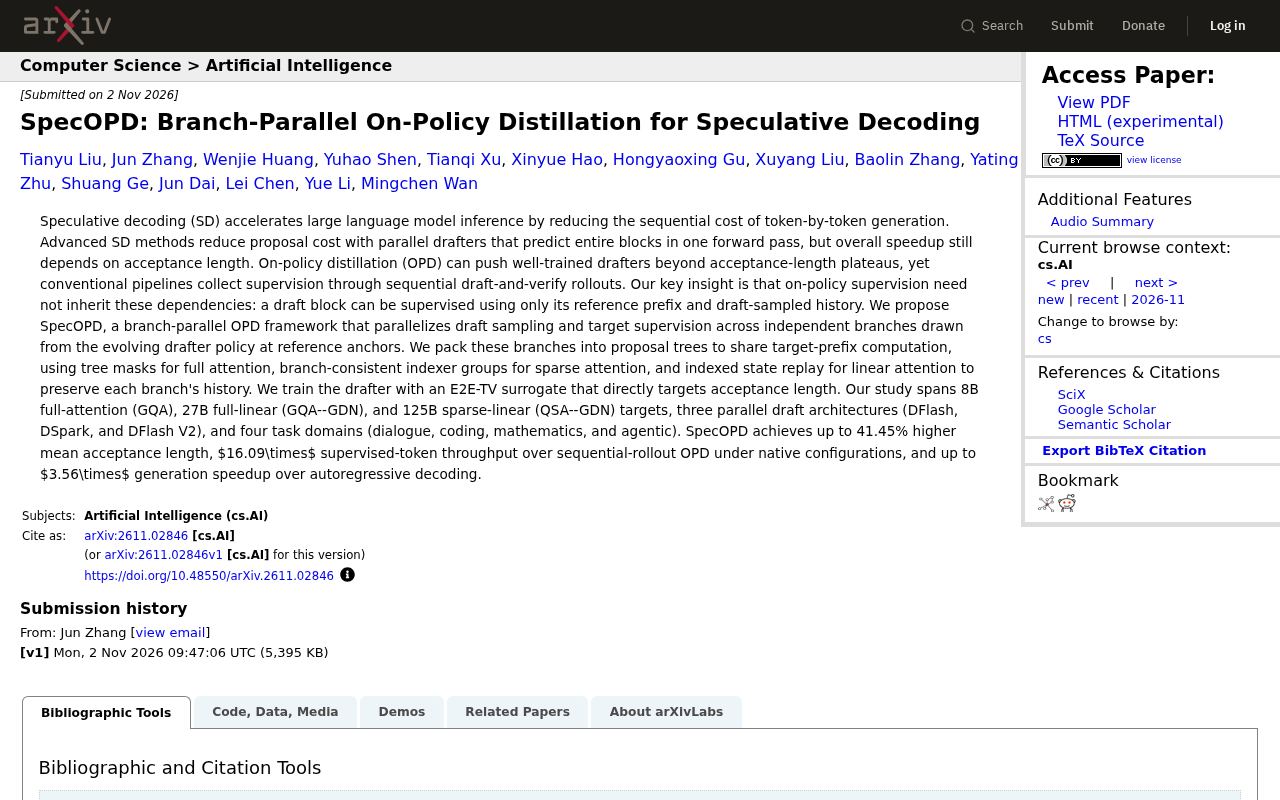
SpecOPD: Branch-Parallel On-Policy Distillation for Speculative Decoding
Speculative decoding (SD) accelerates large language model inference by reducing the sequential cost of token-by-token generation. Advanced SD methods reduce proposal cost with parallel drafters that predict entire blocks in one forward pass, but overall speedup still depends on acceptance length. On-policy distillation (OPD) can push well-trained drafters b
arXiv · Published Oct 27, 2026
HyScale: Scaling Long-Context Training for Learned Sparse Attention
arXiv:2610.32057v2 Announce Type: new Abstract: We present HyScale, a long-context training system for learned sparse attention. Learned sparse attention is a promising architecture for million-token contexts, widely adopted in production since DeepSeek-V3.2. Selection, however, grows into the training bottleneck. For each query, it scores every previous tok
View source record →arXiv · Published Oct 26, 2026
LazyFlash: Forward-Dense, Backward-Sparse Attention for Accelerated Long-Context Fine-Tuning
arXiv:2610.31911v1 Announce Type: new Abstract: As large language models (LLMs) process increasingly long sequences, attention becomes a major computational bottleneck. Sparse attention mostly targets inference, yet many methods still train densely or cannot support sparse training, and their added complexity makes sparsity hard to turn into wall-clock speed
View source record →arXiv · Published Oct 15, 2026
Joint Subspace Sparse Attention for Efficient Long-Context Decoding
View source record →arXiv · Published Oct 9, 2026
Sparse Attention Is Matrix Approximation, Not Choosing from a Bag of Values
View source record →GitHub Releases · Published Aug 26, 2026
Release: v5.16.0
Release v5.16.0 New Model additions Qwen4-Exp Qwen4-Exp builds on Qwen3.5's hybrid text and multimodal architecture with three key components: GatedResidual (GR), Qwen Sparse Attention (QSA), and Per-Layer Embedding (PLE). GR is a Qwen-developed residual architecture that combines Hyper-Connection with GatedNorm. It mixes multiple residual streams with fine-
View source record →
Review priority 41 / 100
This score orders research candidates. It is not search volume, a forecast or verified commercial demand.
Evidence
8 / 30Distinct dated articles or first observations; repeat crawling adds nothing.
Publisher diversity
8 / 25Conservative owner grouping; syndicated copies count once.
Comparable change
0 / 20Comparable complete weeks only; no percentage from a zero baseline.
Recent evidence
15 / 15Latest publication or first observation, not repeated fetch time.
Name specificity
9.7 / 10Explicit entities and technical concepts outrank ambiguous acronyms.
Limitations and interpretation
- First observation is a collection milestone, not proof that a word or product is new to the world.
- Counts describe monitored public sources, not the whole web or search demand.
- First observed here is not the invention date of a name or idea.
- Candidates come from public titles, summaries and entity URLs, not verified full-text analysis.
- Owner grouping is conservative; undisclosed syndication may remain.
- Repeat ranking appearances are observations, not new articles or independent endorsements.
- An established concept or common product name retained as a baseline, not a newly invented term.
- Both weeks need adequate, comparable collection coverage.
- Sources behind this term changed or lack a comparable baseline.
- Recent evidence includes collection over three days after publication.
- Current evidence comes from one publisher or owner.