Diffusion language models
Name variants diffusion language model · 扩散语言模型
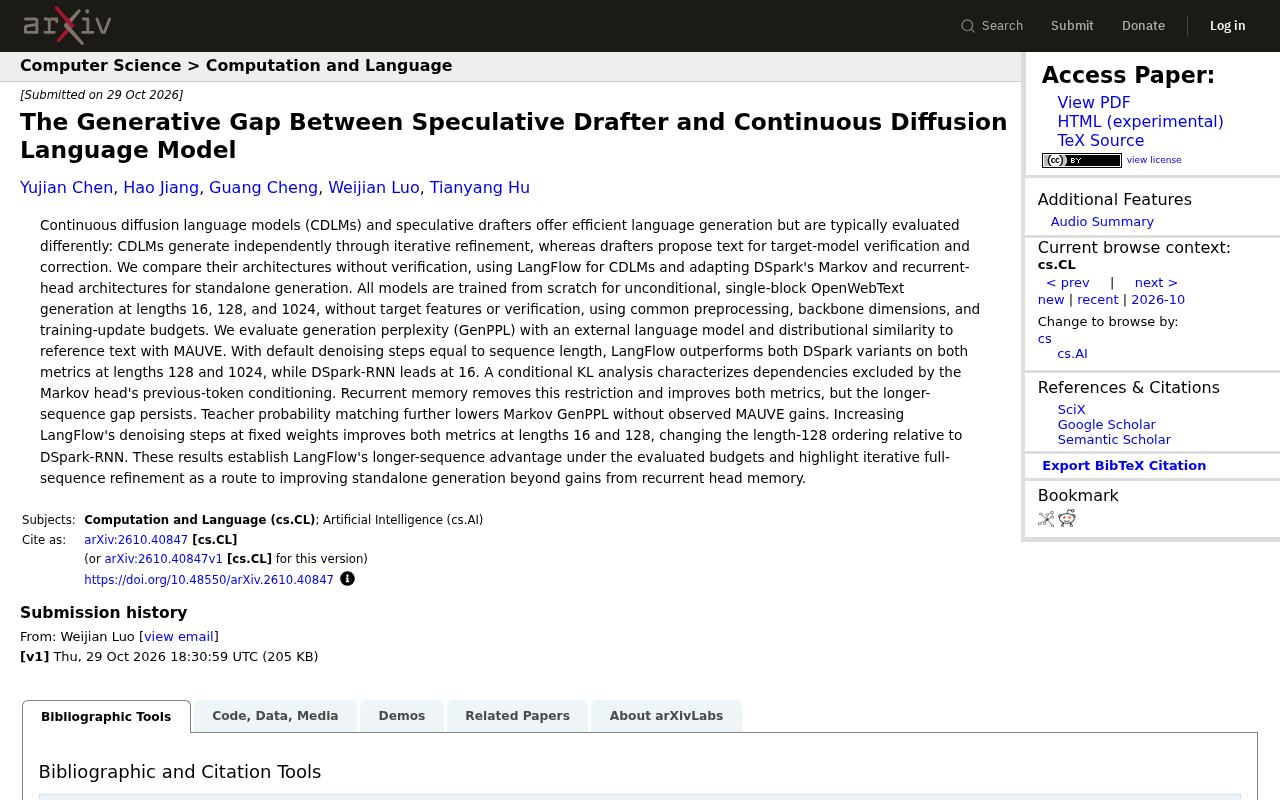
arXiv:2610.40847v1 Announce Type: new Abstract: Continuous diffusion language models (CDLMs) and speculative drafters offer efficient language generation but are typically evaluated differently: CDLMs generate independently through iterative refinement, whereas drafters propose text for target-model verification and correction. We compare their architectures
This explanation quotes or summarizes the cited source record. Saving creates a bookmark on this device, with no automatic account sync.
- First observed in our collection
- Oct 9, 2026, 3:45 PM UTC
- Earliest cited publication
- Oct 9, 2026, 4:00 AM UTC
- Last observed
- Nov 2, 2026, 5:00 AM UTC
Evidence in the last complete seven days
- Source mentions
- 2 Previous seven days 5
- Distinct sources
- 1 Previous 1
- Comparable growth
- Not comparable
- Ranking appearances
- 0
Collection observations and undated records are separate from dated publication counts. Observed in 7d:2 · Undated records:0
Collection coverage · Limited historyCurrent / previous observed days 7 / 3
Counts use complete UTC days. First observed means first seen by this collection, not when a term was coined.
Current window:2026-10-29 → 2026-11-05 (end excluded) · History 11 days
| Source | Current days | Previous days | Last success |
|---|---|---|---|
| arXiv | 6 | 3 | Nov 5, 2026, 10:00 AM UTC |
| arXiv | 7 | 2 | Nov 5, 2026, 10:01 AM UTC |
| Ask HN | 7 | 3 | Nov 5, 2026, 3:00 PM UTC |
| Ask HN | 7 | 3 | Nov 5, 2026, 2:30 PM UTC |
| Ask HN | 7 | 3 | Nov 5, 2026, 3:00 PM UTC |
| Ask HN | 7 | 3 | Nov 5, 2026, 3:00 PM UTC |
| GitHub | 7 | 3 | Nov 5, 2026, 12:15 PM UTC |
| GitHub Issues | 7 | 3 | Nov 5, 2026, 10:01 AM UTC |
| GitHub Releases | 7 | 1 | Nov 5, 2026, 12:00 PM UTC |
| GitHub | 7 | 3 | Nov 5, 2026, 2:30 PM UTC |
| GitHub Issues | 7 | 3 | Nov 5, 2026, 10:01 AM UTC |
| GitHub Releases | 7 | 3 | Nov 5, 2026, 3:14 PM UTC |
| GitHub | 7 | 3 | Nov 5, 2026, 2:30 PM UTC |
| GitHub Issues | 7 | 3 | Nov 5, 2026, 10:01 AM UTC |
| GitHub Releases | 7 | 3 | Nov 5, 2026, 3:14 PM UTC |
| GitHub Discovery | 0 | 0 | Nov 5, 2026, 3:13 PM UTC |
| GitHub Trending | 7 | 3 | Nov 5, 2026, 3:14 PM UTC |
| 7 | 2 | Nov 5, 2026, 10:00 AM UTC | |
| Hugging Face | 7 | 2 | Nov 5, 2026, 8:15 AM UTC |
| Hugging Face Spaces | 0 | 0 | Nov 5, 2026, 3:13 PM UTC |
| Hacker News | 7 | 3 | Nov 5, 2026, 12:45 PM UTC |
| Hacker News | 7 | 3 | Nov 5, 2026, 3:30 PM UTC |
| Hacker News | 7 | 3 | Nov 5, 2026, 3:30 PM UTC |
| Hacker News | 0 | 0 | Nov 5, 2026, 3:13 PM UTC |
| Show HN | 0 | 0 | Nov 5, 2026, 3:13 PM UTC |
| MIT News | 7 | 2 | Nov 5, 2026, 10:01 AM UTC |
| OpenAI | 7 | 3 | Nov 5, 2026, 11:30 AM UTC |
| Product Hunt | 7 | 3 | Nov 5, 2026, 12:45 PM UTC |
| 量子位 | 7 | 3 | Nov 4, 2026, 10:15 AM UTC |
| OpenRouter | 0 | 0 | Nov 5, 2026, 3:41 PM UTC |
| Hugging Face Models | 0 | 0 | Nov 5, 2026, 3:41 PM UTC |
| HF Daily Papers | 0 | 0 | Nov 5, 2026, 3:41 PM UTC |
| OpenRouter | 0 | 0 | Nov 5, 2026, 3:41 PM UTC |
| SEC EDGAR | 7 | 3 | Nov 5, 2026, 10:30 AM UTC |
| Sequoia Capital | 7 | 2 | Nov 5, 2026, 10:00 AM UTC |
| Simon Willison | 0 | 0 | Nov 5, 2026, 3:13 PM UTC |
| TechCrunch | 7 | 3 | Nov 5, 2026, 2:30 PM UTC |
| Contracts Finder | 7 | 3 | Nov 5, 2026, 10:00 AM UTC |
| V2EX | 7 | 3 | Nov 5, 2026, 2:30 PM UTC |
- Counts describe monitored public sources, not the whole web or search demand.
- Both weeks need adequate, comparable collection coverage.
Daily history · up to 90 days
Bars show dated source mentions. The latest UTC day may be incomplete. Zero mentions and missing collection coverage are different conditions.
Dotted markers indicate days with no record. They are not counted as zero mentions.
View accessible daily data
| UTC date | Mentions | Sources | Observations | Ranking appearances |
|---|---|---|---|---|
| 2026-10-09 | 1 | 1 | 1 | 0 |
| 2026-10-10 · No record | — | — | — | — |
| 2026-10-11 · No record | — | — | — | — |
| 2026-10-12 · No record | — | — | — | — |
| 2026-10-13 · No record | — | — | — | — |
| 2026-10-14 · No record | — | — | — | — |
| 2026-10-15 · No record | — | — | — | — |
| 2026-10-16 · No record | — | — | — | — |
| 2026-10-17 · No record | — | — | — | — |
| 2026-10-18 · No record | — | — | — | — |
| 2026-10-19 · No record | — | — | — | — |
| 2026-10-20 · No record | — | — | — | — |
| 2026-10-21 · No record | — | — | — | — |
| 2026-10-22 | 3 | 1 | 2 | 0 |
| 2026-10-23 | 0 | 0 | 1 | 0 |
| 2026-10-24 | 0 | 0 | 0 | 0 |
| 2026-10-25 | 0 | 0 | 0 | 0 |
| 2026-10-26 | 0 | 0 | 1 | 0 |
| 2026-10-27 | 2 | 1 | 1 | 0 |
| 2026-10-28 | 0 | 0 | 0 | 0 |
| 2026-10-29 | 0 | 0 | 0 | 0 |
| 2026-10-30 | 0 | 0 | 0 | 0 |
| 2026-10-31 | 0 | 0 | 0 | 0 |
| 2026-11-01 | 0 | 0 | 0 | 0 |
| 2026-11-02 | 2 | 1 | 2 | 0 |
| 2026-11-03 | 0 | 0 | 0 | 0 |
| 2026-11-04 | 0 | 0 | 0 | 0 |
| 2026-11-05 | 0 | 0 | 0 | 0 |
Source evidence
Sources in the evidence shown:arXiv 8
arXiv · Published Nov 2, 2026
The Generative Gap Between Speculative Drafter and Continuous Diffusion Language Model
arXiv:2610.40847v1 Announce Type: new Abstract: Continuous diffusion language models (CDLMs) and speculative drafters offer efficient language generation but are typically evaluated differently: CDLMs generate independently through iterative refinement, whereas drafters propose text for target-model verification and correction. We compare their architectures
View source record →arXiv · Published Nov 2, 2026
BYOD: Build Your Own DLM - Efficient Autoregressive-to-Diffusion Language Model Conversion
arXiv:2610.41574v1 Announce Type: new Abstract: Unlike autoregressive (AR) models, diffusion language models (DLMs) permit parallel token updates, flexible generation, and bidirectional attention, but leading systems rely on costly pretraining or full-model fine-tuning. We present Build Your Own DLM (BYOD), a generalizable LoRA-only recipe for parameter-effi
View source record →arXiv · Published Oct 27, 2026
DELA: Learning Controllable Edits for Diffusion Language Models
arXiv:2610.32096v1 Announce Type: new Abstract: Diffusion language models (DLMs) support bidirectional denoising and iterative refinement, but generation remains largely controlled by token-level masking schedules. This leaves draft-level refinement implicit and limits explicit control over when to insert missing content, delete redundant spans, revisit unce
View source record →arXiv · Published Oct 27, 2026
TraceQuery: learning what to recompute from full-denoising trajectory in diffusion language models
arXiv:2610.33008v1 Announce Type: new Abstract: Diffusion large language models (dLLMs) enable flexible generation through iterative masked denoising, but incur substantial inference cost because token representations are repeatedly recomputed across denoising steps. Existing cache-based methods reduce this cost by reusing intermediate results across denoisi
View source record →arXiv · Published Oct 22, 2026
Hidden Messages Between Diffusion Language Model Agents: Causal Evidence for Latent Communication
arXiv:2610.28905v1 Announce Type: new Abstract: Diffusion language models form answers through a sequence of revisable continuous states, but multi-agent systems usually discard those states and make agents communicate only after decoding text. We ask whether one independent diffusion trajectory can pass a compact hidden message into another and, crucially,
View source record →arXiv · Published Oct 22, 2026
DiffResearch: Accelerating Deep Research with Diffusion Language Models
arXiv:2610.28909v1 Announce Type: new Abstract: Deep research systems iteratively plan, gather evidence, synthesize, and revise, making end-to-end latency a key bottleneck for interactive use. Almost all production systems are built on autoregressive (AR) language models and inherit left-to-right decoding in planning and long-form writing. We present DiffRes
View source record →arXiv · Published Oct 22, 2026
GRAFT: Restoring the Missing Sampling Interface in Continuous Diffusion Language Models
arXiv:2610.29136v1 Announce Type: new Abstract: Continuous diffusion language models generate a whole sequence in parallel, never drawing a single word at any intermediate step; only the final step turns embeddings into text. Models such as ELF now report autoregressive-level quality at a fraction of the sampling steps of discrete-token diffusion models, and
View source record →arXiv · Published Oct 9, 2026
Plan-and-Patch: Diffusion Language Models for Agentic Planning
View source record →
Review priority 42 / 100
This score orders research candidates. It is not search volume, a forecast or verified commercial demand.
Evidence
12.7 / 30Distinct dated articles or first observations; repeat crawling adds nothing.
Publisher diversity
8 / 25Conservative owner grouping; syndicated copies count once.
Comparable change
0 / 20Comparable complete weeks only; no percentage from a zero baseline.
Recent evidence
11.3 / 15Latest publication or first observation, not repeated fetch time.
Name specificity
9.7 / 10Explicit entities and technical concepts outrank ambiguous acronyms.
Limitations and interpretation
- First observation is a collection milestone, not proof that a word or product is new to the world.
- Counts describe monitored public sources, not the whole web or search demand.
- First observed here is not the invention date of a name or idea.
- Candidates come from public titles, summaries and entity URLs, not verified full-text analysis.
- Owner grouping is conservative; undisclosed syndication may remain.
- An established concept or common product name retained as a baseline, not a newly invented term.
- Both weeks need adequate, comparable collection coverage.
- Sources behind this term changed or lack a comparable baseline.
- Current evidence comes from one publisher or owner.